


Condensation on windows can be caused by inadequate ventilation, but there are often other reasons for this problem.
To check whether this problem is due to ventilation, you need to measure the humidity level. It is rare to have high indoor humidity levels in winter, and the problem is rarely due to ventilation. A good climate is considered to be a temperature of around 20 degrees and a relative humidity level of 40-50%.
In winter, we often have low humidity, and some people, such as those with asthma, are bothered by excessively low humidity. High humidity naturally occurs in bathrooms and other wet rooms, but this is often short-lived, and ventilation should be able to handle this problem.
When a surface reaches dew point temperature, condensation forms on that surface. This is what happens when condensation forms on the inside of windows, for example. Condensation begins to form at the bottom of the glass surface due to stagnant air and the cooling effect from outside.
Placing windows near exterior walls, underfloor heating and curtains exacerbates the problem as the air becomes more stagnant and the glass cools down to the dew point temperature. Even at low humidity levels, this can occur at low outdoor temperatures.
Example Measure the temperature of the glass surface at the bottom of the window, or where condensation forms first. An outdoor/indoor thermometer can be used by taping the outdoor sensor to the glass. An IR thermometer can also be used if you place a piece of tape on the glass and aim the measuring point at the tape to measure the correct surface. If you also know the relative humidity, you will get the answer.
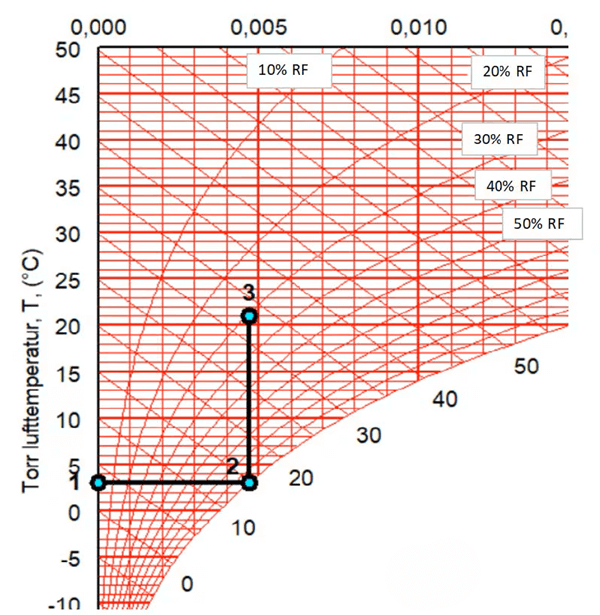
Mollier diagram Ex.
- Point 3: Room temperature 21 degrees Room humidity 30% RF In this example, point 3 is on the 30 RF curve and the temperature is read from the bar on the left.
- Point 2: Go straight down the chart to the lowest curve.
- Point 1: Go to the left of the diagram and read the dew point temperature = approx. 3 degrees. Condensation forms on surfaces that maintain a temperature of 3 degrees or lower. Using the Mollier diagram or an app, the dew point temperature can be determined if the humidity and temperature in the room are known.
Conversely, by measuring the surface temperature (point 1), you can go from point 1 to point 2 and straight up to the room temperature, where you can read the maximum relative humidity that can be allowed before condensation forms on the surface in question.